

A Practical, Everyday Guide to Balance, Opposites, and Harmony
Yin and yang is one of those phrases you hear everywhere—on yoga studio walls, tattoos, self-help books, wellness blogs, and even memes. But despite how common it is, many people only have a vague idea of what yin and yang actually means.
Is it about good versus evil? Light versus dark? Male versus female?
Not exactly.
Yin and yang is a deep philosophical concept from ancient Chinese thought that explains how opposite forces are interconnected, interdependent, and constantly transforming into one another. Rather than seeing the world in rigid categories, yin and yang helps us understand balance, change, and flow—whether we’re talking about nature, health, emotions, relationships, or daily life.
In this guide, we’ll break down yin and yang in clear, approachable language. You’ll learn what it means, where it comes from, how it shows up in everyday life, and how to recognize imbalance—just like spotting symptoms in a health guide.
What Does Yin and Yang Mean?
At its core, yin and yang describes two complementary forces that exist in everything.
- Yin represents qualities like darkness, stillness, coolness, softness, and receptivity
- Yang represents qualities like light, movement, warmth, strength, and activity
The key idea is that neither yin nor yang is “better” than the other. They only make sense in relation to each other.
Think of day and night. You can’t have one without the other—and each eventually turns into the other.
The Most Important Principle
Yin and yang are not opposites that fight—they are partners that balance.
The Origins of Yin and Yang
Ancient Chinese Philosophy
Yin and yang comes from ancient Chinese philosophy, dating back over 3,000 years. It appears prominently in:
- Taoism
- Traditional Chinese Medicine (TCM)
- Martial arts
- Chinese cosmology
The concept is closely linked to the Tao (or Dao), which means “the way” or “the natural order of the universe.”
Rather than trying to control life, Taoist philosophy encourages people to live in harmony with natural rhythms—and yin and yang is the framework that explains how those rhythms work.
Understanding the Yin-Yang Symbol (Taijitu)
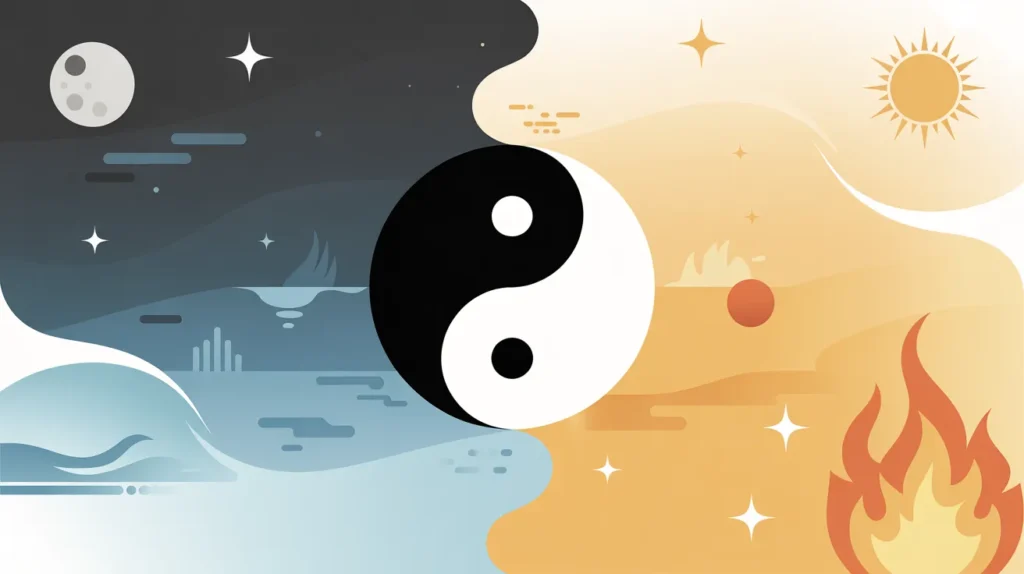
The familiar black-and-white circle is called the Taijitu, and it visually explains the entire concept.
Visual Cues in the Symbol
- The black half (yin) contains a small white dot (yang)
- The white half (yang) contains a small black dot (yin)
- The shape is circular, showing wholeness and continuity
- The curved line shows movement, not division
What the Symbol Teaches Us
- Yin always contains some yang
- Yang always contains some yin
- Nothing is ever 100% one or the other
- Balance is dynamic, not static
This is why yin and yang is often misunderstood—it’s not about choosing sides.
Common Yin and Yang Characteristics
Yin Qualities
Yin is associated with:
- Night
- Moon
- Cold
- Rest
- Quiet
- Intuition
- Reflection
- Water
- Earth
- Feminine energy (not gender)
Yang Qualities
Yang is associated with:
- Day
- Sun
- Heat
- Activity
- Sound
- Logic
- Action
- Fire
- Sky
- Masculine energy (not gender)
Important note: Yin and yang do not mean women vs. men. Every person contains both.
Yin and Yang in Everyday Life
One of the reasons yin and yang has lasted for thousands of years is because it’s incredibly practical.
Daily Examples
- Sleep (yin) balances work (yang)
- Listening (yin) balances speaking (yang)
- Winter (yin) balances summer (yang)
- Inhaling (yin) balances exhaling (yang)
When life feels “off,” it’s often because one force is overpowering the other.
Yin and Yang in Health and Well-Being
Traditional Chinese Medicine uses yin and yang to explain health, illness, and recovery.
Balanced Health
A healthy body has:
- Enough yin to nourish and cool
- Enough yang to energize and warm
Signs of Yin Imbalance (Too Little Yin)
Comparable to “symptoms” in a health guide:
- Dry mouth or skin
- Insomnia
- Irritability
- Feeling overheated
- Restlessness
- Anxiety at night
Signs of Yang Imbalance (Too Little Yang)
- Fatigue
- Cold hands and feet
- Low motivation
- Sluggish digestion
- Depression
- Feeling heavy or slow
In TCM, treatment focuses on restoring balance, not attacking symptoms alone.
Yin and Yang in Emotions and Mental Health
Emotional Yin
- Calmness
- Reflection
- Emotional processing
- Stillness
- Sensitivity
Emotional Yang
- Motivation
- Confidence
- Expression
- Assertiveness
- Drive
Emotional Imbalance Examples
- Too much yang → burnout, anger, impulsiveness
- Too much yin → withdrawal, stagnation, rumination
Healthy emotional life requires both.
Yin and Yang in Relationships
Relationships thrive when yin and yang are balanced between partners—and within each person.
Healthy Relationship Balance
- One person speaks (yang), the other listens (yin)
- One leads, the other supports
- Energy flows back and forth naturally
Unbalanced Dynamics
- One partner always dominates (excess yang)
- One partner always withdraws (excess yin)
- Conflict arises when balance is lost
Yin and yang reminds us that roles can shift—and should.
Yin and Yang in Nature
Nature is the clearest teacher of yin and yang.
Natural Examples
- Tide going out (yin) → tide coming in (yang)
- Seed buried underground (yin) → plant growing upward (yang)
- Still lake (yin) → rushing river (yang)
Nothing stays the same forever.
Where Yin and Yang Can Be Found or Live
Although yin and yang are not physical creatures, they “live” everywhere energy, change, and balance exist.
Environments Where Yin and Yang Are Found
- Nature
- Seasons
- Weather patterns
- Day/night cycles
- Human bodies
- Organs
- Hormonal systems
- Sleep-wake cycles
- Human behavior
- Work and rest
- Emotions and logic
- Action and reflection
- Built environments
- Quiet rooms vs. busy streets
- Warm lighting vs. bright lighting
Wherever there is movement and stillness, yin and yang are present.
Common Misconceptions About Yin and Yang
“Yin Is Bad and Yang Is Good”
False.
Both are essential and morally neutral.
“You Should Aim for Perfect Balance All the Time”
Balance constantly shifts. The goal is awareness, not perfection.
“Yin and Yang Is Religious”
It’s philosophical and practical, not a belief system you must “follow.”
Practical Tips for Applying Yin and Yang in Daily Life
If Life Feels Too Chaotic (Excess Yang)
Add yin:
- Rest more
- Reduce stimulation
- Practice meditation
- Spend time in nature
- Eat cooling foods
If Life Feels Stagnant (Excess Yin)
Add yang:
- Move your body
- Get sunlight
- Set small goals
- Socialize
- Eat warming foods
Small adjustments matter.
Yin and Yang in Modern Culture
Today, yin and yang appears in:
- Yoga and meditation practices
- Wellness and self-care routines
- Psychology and coaching
- Martial arts like Tai Chi
- Art, tattoos, and design
Its staying power comes from its flexibility and universality.
Why Yin and Yang Still Matters Today
In a world that glorifies constant productivity, yin and yang reminds us:
- Rest is productive
- Slowness has value
- Stillness creates clarity
- Opposites can cooperate
It offers a kinder, more sustainable way to live.
Frequently Asked Questions (FAQ)
1. Is yin and yang the same as good and evil?
No. Yin and yang are complementary forces, not moral judgments. Both are necessary and natural.
2. Can a person be more yin or more yang?
Yes, people often lean one way, but everyone contains both. Balance can change over time.
3. Is yin and yang connected to Chinese medicine?
Yes. Traditional Chinese Medicine uses yin and yang to diagnose and treat imbalance in the body.
4. Does yin and yang apply to mental health?
Absolutely. Emotional balance often reflects a healthy yin-yang relationship between rest and action, reflection and expression.